
You’ve read about sediment. You’ve learned about biofilm. You’ve probably opened your cistern lid and looked inside with a flashlight. Now what?
Now you clean it. This is where knowledge converts to action — the single most impactful maintenance activity for your water system. A professional cistern cleaning resets your water quality to baseline, removes the accumulated contamination of months or years, and gives you a clean foundation for everything else.
This guide covers exactly what happens during a professional cleaning, what to look for in a provider, when DIY is appropriate, and a critical safety warning that could save your life.
What Cistern Cleaning Involves
Professional cistern cleaning is a 5-step process: (1) drain the cistern completely using a submersible pump, (2) physically scrub all interior walls and floor to remove biofilm and sediment, (3) disinfect with concentrated chlorine solution, (4) rinse thoroughly to remove disinfectant residue, and (5) refill with fresh water. A proper service takes 3-6 hours depending on cistern size and contamination level, costs typical cleaning cost, expected $1,500-4,000 MXN, and should include before-and-after photo documentation. In Cabo’s warm climate, cleaning is recommended every 6-12 months.
Why Cabo Cisterns Need More Frequent Cleaning
Generic cleaning recommendations from the U.S. or Europe suggest annual cistern maintenance. In Los Cabos, the conditions that drive contamination are more aggressive: ground temperatures of 22-28°C accelerate biofilm maturation, chlorine residual decays faster in warm water, pipa deliveries introduce sediment more frequently than municipal connections, and the hard water produces mineral precipitation that adds to the sediment layer continuously. A Cabo cistern at 12 months without cleaning is typically in worse condition than a temperate-climate cistern at 24 months. This is why we recommend 6-month cleaning cycles for properties without inlet filtration, and 12-month cycles for properties with good inlet filtration and sealed lids.
The Professional Cleaning Process
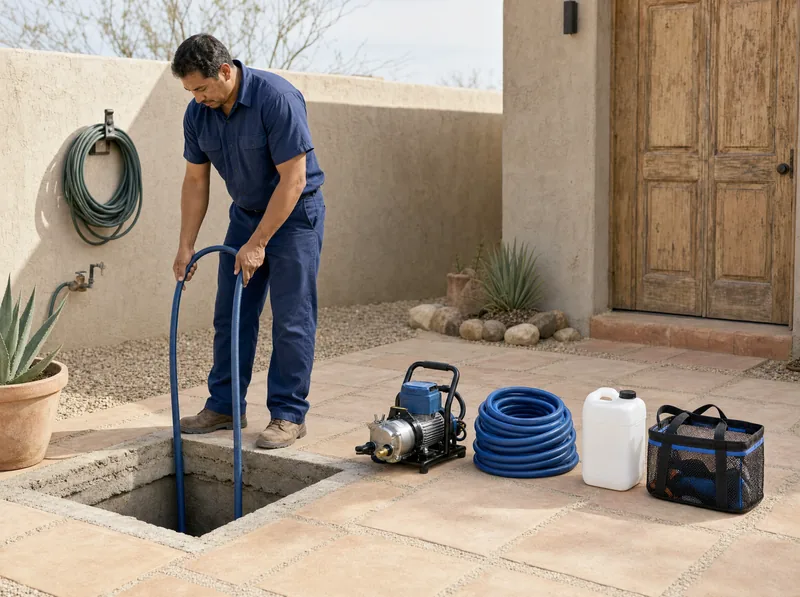
Step 1: Drain. A submersible pump removes all water from the cistern. The last few centimeters — the most sediment-laden water — are pumped out along with the settled sludge. This takes 30-60 minutes for a typical 10,000L residential cistern. The homeowner should plan for 6-8 hours without water service during the cleaning.
Step 2: Scrub. This is the step that matters most and the step most shortcuts compromise. A worker enters the cistern (see safety section below) and physically scrubs every interior surface — walls, floor, corners, pipe entries — with stiff brushes and a chlorine solution. The scrubbing mechanically dislodges biofilm that chemical treatment alone cannot penetrate. All loosened material is swept to the drain point and pumped out. For smaller cisterns where physical entry isn’t possible, long-handled brushes and pressure washing equipment are used from the access lid.
Step 3: Disinfect. After scrubbing, the interior surfaces are treated with a concentrated chlorine solution — typically recommended concentration, expected 50-100 mg/L (ppm) sodium hypochlorite — applied to all surfaces and allowed to sit for 30 minutes minimum. This kills any remaining microorganisms on the scrubbed surfaces.
Step 4: Rinse. The disinfectant is flushed from the cistern with clean water. The rinse water is pumped out. This prevents excessive chlorine from entering the household water supply when the tank is refilled.
Step 5: Refill and document. Fresh water is introduced (either from a pipa or municipal supply). The service provider documents the cleaning with before-and-after photos and should provide a written receipt detailing the date, cistern size, process performed, and any observations about the cistern’s condition (cracks, damaged fittings, structural concerns).
Choosing a Cleaning Provider
Look for: Process documentation (before-and-after photos are non-negotiable). Clear description of the 5-step process. Willingness to let you observe. Proper safety equipment for confined space entry. References from local customers. A business card or formal identity — not just a WhatsApp number.
Red flags: Won’t show you before-and-after photos. Claims the cleaning takes only 1-2 hours (it can’t — not properly). Won’t explain their process. No safety equipment visible. Significantly below-market pricing (they’re cutting steps). Only offers to “add chlorine” without physical scrubbing.
Expect to pay: cleaning cost range by cistern size — 5,000L: $1,000-2,000 MXN, 10,000L: $1,500-3,000 MXN, 20,000L: $2,500-4,500 MXN Price should include drainage, scrubbing, disinfection, rinse, and documentation. Refill water (pipa) is typically an additional cost arranged separately.
⚠️ Critical Safety Warning: Confined Space Hazards
Cisterns are confined spaces. Entering a cistern without proper precautions can kill you.
This is not an exaggeration. Confined space incidents — where workers enter enclosed tanks, manholes, or underground chambers — cause fatalities every year in Mexico and worldwide. The hazards in a cistern include:
Oxygen depletion. Biological activity (decomposing organic matter, bacterial metabolism) can consume oxygen in a sealed underground space, dropping O2 levels below the 19.5% minimum for safe breathing. You can lose consciousness in seconds without warning.
Toxic gas accumulation. Hydrogen sulfide (H2S) from decomposing organic matter and bacterial activity can accumulate in cisterns. H2S is heavier than air, collects at the bottom of enclosed spaces, and is lethal at concentrations above 100 ppm. At lower concentrations, it deadens your sense of smell — you stop detecting the characteristic rotten-egg odor before the gas reaches dangerous levels.
Drowning. Water can enter a cistern unexpectedly (automatic pump activation, float valve opening, rainfall through unsealed lid). Even a few centimeters of water in a confined space with impaired consciousness can be fatal.
Professional providers have: Gas monitors, forced-air ventilation, safety harnesses, a standby person at the access point at all times, and confined space entry training.
DIY cleaning should NEVER involve entering the cistern unless you have professional confined space equipment and training. For DIY maintenance, work from the access lid using long-handled brushes, or restrict yourself to tinaco cleaning (smaller, above-ground, lower risk). The cistern interior is for trained professionals with proper equipment.
Cleaning Is the Reset Button
Every other intervention in the water quality system — inlet filtration, treatment, monitoring — works better on a clean foundation. Inlet filters prevent new sediment from entering, but they can’t remove the sediment already inside. Treatment systems produce better output with cleaner input. Water quality measurements are more meaningful when the baseline is known.
A cistern cleaning is the reset button. It establishes the cleanest possible starting point for your storage system, from which the clock starts ticking again. How fast the clock runs — how quickly the cistern returns to its pre-cleaning state — depends on what you do afterward. Inlet filtration slows the clock. Sealed lids and screened vents slow it further. Regular cleaning on a schedule resets it before conditions deteriorate.
What to Do
Right now: If you don’t know when your cistern was last cleaned — or if it’s been more than 12 months — schedule a professional cleaning. Ask neighbors or your HOA for provider recommendations, or check the service directory.
Before the cleaning: Don’t schedule a pipa delivery for the same day. Plan for 6-8 hours without water. Have the access lid clear and accessible. Ask the provider to include the tinaco in the cleaning if they offer it.
After the cleaning: Install an inlet filter before the next pipa delivery. Set a calendar reminder for the next cleaning based on the recommended frequency for your property. Take your own baseline water quality measurement (TDS, chlorine) to track between cleanings.
What It Costs vs. What It Saves
Professional cistern cleaning: $1,500-4,000 MXN per service, 1-2x per year = $2,000-8,000 MXN/year.
What that cleaning prevents annually: pump wear ($1,000-3,000 MXN/year amortized), water heater damage ($2,000-5,000 MXN/year), filter overconsumption ($500-1,500 MXN/year), appliance scaling ($1,000-3,000 MXN/year). Total prevented damage: $5,000-12,000+ MXN/year.
The cleaning pays for itself 2-3x over annually in prevented equipment costs alone — before accounting for the health protection, taste improvement, and peace of mind.
Frequently Asked Questions
Can I clean my cistern myself? ¿Puedo limpiar mi cisterna yo mismo? You can clean your tinaco (rooftop tank) yourself — it’s smaller, above-ground, and lower risk. For the underground cistern, do not enter the tank without professional confined space equipment and training. You can use long-handled brushes from the access lid for partial maintenance between professional cleanings, but a full cleaning requires drainage and interior access that should be done by trained professionals.
How long does a professional cleaning take? ¿Cuánto tiempo toma una limpieza profesional? 3-6 hours for a standard 10,000L residential cistern, depending on contamination level. Plan for 6-8 hours without water service. Heavily contaminated cisterns or larger tanks may take longer.
Should I be present during the cleaning? ¿Debería estar presente durante la limpieza? Yes, if possible — especially for the first cleaning. Seeing the before-and-after state of your cistern is educational and motivating. It also allows you to ask questions, inspect the work, and ensure the provider completes all five steps properly.
How do I find a reliable cleaning service? ¿Cómo encuentro un servicio de limpieza confiable? Ask neighbors, your HOA, or local expat communities for recommendations. The service directory lists vetted providers in Los Cabos. Key criteria: documented 5-step process, before-and-after photos, proper safety equipment, and willingness to explain their methods.
What if my cistern has structural damage? ¿Qué pasa si mi cisterna tiene daño estructural? A cleaning service may discover cracks, deteriorated waterproofing, corroded fittings, or other structural issues. These should be repaired before refilling — a crack that lets groundwater in introduces untreated, unfiltered water continuously. Your cleaning provider should flag any structural concerns in their documentation.
Related Reading
How often should you clean? Cleaning Frequency Guide
What’s living on the walls? Biofilm: The Invisible Threat
What’s at the bottom? The Sediment Multiplier
The essential post-cleaning upgrade: Inlet Filtration
Schedule a Cleaning
Find a vetted cistern cleaning provider in Los Cabos through the service directory, or assess your cleaning urgency with the Water Health Diagnostic.