You don’t know how much water is in your cistern right now. Neither does anyone else in Cabo — not unless they physically open the lid and look inside, which almost nobody does between pipa deliveries.
This means you don’t know when you’ll run dry. You don’t know if last night’s running toilet leaked 300 liters while you slept. You don’t know if the pipa actually delivered the 10,000 liters you paid for. You don’t know your consumption rate, your delivery window, or whether that vacation rental sitting empty is losing water to a slow pipe leak.
You’re managing your most critical household resource — the one that controls your appliance lifespan, your monthly costs, and your water quality — completely blind.
Smart sensors fix that.
What Smart Water Sensors Do
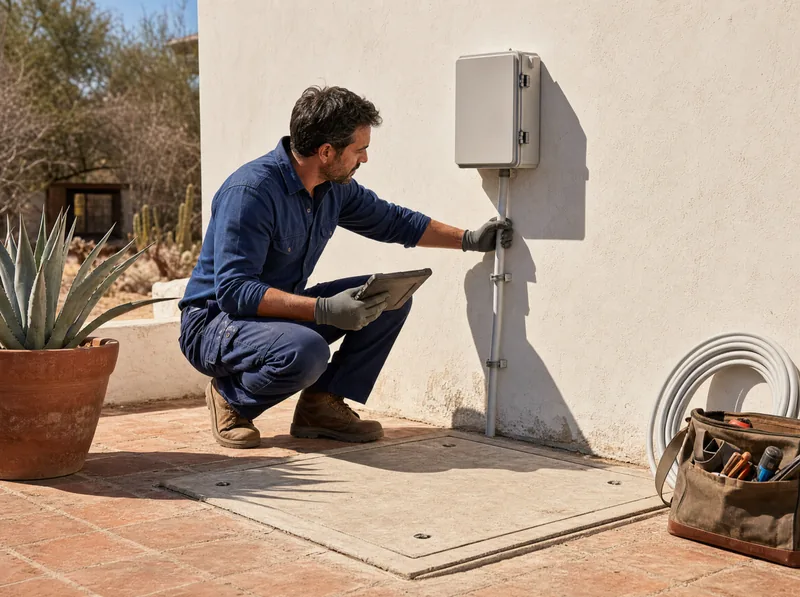
A smart water level sensor continuously measures the water level in your cistern or tinaco, transmits the data to a cloud dashboard accessible from any device, and sends alerts when configurable thresholds are crossed. This gives you: real-time water level visibility, historical consumption tracking, automated pipa delivery prediction, leak detection (unexpected water loss during idle periods), and fill event logging (verifying delivery volume against invoices). Three sensor technologies serve different installations: ultrasonic (non-contact, best for cisterns), capacitive (through-wall, best for plastic tinacos), and submersible pressure (works in any geometry). All connect via Wi-Fi to the same MirAqua dashboard.
Why Cabo Needs This
In a city with centralized metered water, the utility tracks consumption for you. Your bill is your data. In Los Cabos, there’s no meter, no bill, no data. You order pipas by gut feel, run dry by surprise, and discover leaks by running out of water unexpectedly. The emergency premium trap exists because people can’t see their water level in advance.
Smart monitoring transforms water management from reactive to proactive. You see the level dropping. You see the consumption rate. The system predicts when you’ll need your next pipa — and can automatically notify your provider. No more emergency calls. No more 2-3x surcharges. No more running dry at 11 PM on a Saturday.
For vacation rental operators, the value multiplies: you can monitor multiple properties from a single dashboard, detect leaks in vacant units before they become damage claims, verify cleaning-day pipa deliveries remotely, and ensure guest-ready water levels without a site visit.
Three Technologies, One Dashboard
Ultrasonic: The Non-Contact Standard
How it works: Emits a high-frequency sound pulse downward toward the water surface. Measures the time for the echo to return. Converts time to distance, distance to water level.
Strengths: No water contact — no corrosion, no fouling, no mineral buildup. Continuous readings (not stepped). Millimeter accuracy. Zero maintenance beyond occasional dust wipe. Best long-term reliability.
Limitations: Needs a clear path from sensor to water surface — not suitable for tanks with internal baffles or extremely narrow access. Foam or floating debris can affect readings (rare in cisterns). Requires mounting above the waterline.
Best for: Underground concrete cisterns with standard access lids. The recommended default for most Cabo residential installations.
Capacitive: The External Solution
How it works: Detects the presence of water through the tank wall by measuring changes in electrical capacitance. Water’s dielectric constant is ~80x that of air — the difference is unmistakable.
Strengths: Mounts entirely outside the tank — no access required, no internal components, no contamination risk. Works through polyethylene (Rotoplas), HDPE, and fiberglass walls. Extremely simple installation — adhesive strips.
Limitations: Provides stepped readings (water above/below each sensor point) rather than continuous measurement. Not effective through concrete or metal walls. Resolution depends on number of sensor points installed.
Best for: Plastic tinacos (rooftop Rotoplas tanks). Properties where internal tank access isn’t available. Budget-conscious installations wanting basic level monitoring.
Pressure: The Universal Sensor
How it works: A submersible probe on the tank floor measures the hydrostatic pressure of the water column above it. Pressure is directly proportional to water depth, regardless of tank shape.
Strengths: Works in any geometry — round, square, L-shaped, baffled, irregular. Unaffected by foam, floating objects, or internal obstructions. High precision. The most versatile technology.
Limitations: Probe contacts the water — Cabo’s hard water causes mineral scaling on the probe over time. Requires annual cleaning during cistern maintenance. Slightly more involved installation (cable routing through access).
Best for: Concrete cisterns with irregular geometry or internal baffles. Shared condo cisterns. Commercial installations where absolute accuracy matters.
What You See on the Dashboard
Real-time level. Current water volume in liters and percentage of capacity. Updated every 30 seconds. Visible from any device with a web browser — phone, tablet, laptop, anywhere in the world.
Consumption history. A time-series graph showing water level over hours, days, weeks, and months. The sawtooth pattern of daily consumption and periodic pipa fills tells a clear story of how your household uses water. Spikes, anomalies, and trends are immediately visible.
Pipa delivery prediction. Based on your rolling consumption rate, the system calculates when you’ll need your next delivery. It can send you a reminder at a configurable threshold (e.g., “cistern at 30% — schedule delivery for Thursday”) or notify your pipa provider directly.
Fill event logging. Every pipa delivery is automatically detected and logged: date, time, volume delivered (measured by the level change). Compare actual delivered volume against invoiced volume. Track provider reliability over time.
Leak detection. The system’s most valuable safety feature. During periods of known zero consumption (overnight, while away), any water level decline indicates a leak. A running toilet at 200-400 liters/day shows up as a steady overnight decline that’s invisible to the eye but unmistakable in the data.
Leak Detection: The Hidden Payoff
Leaks are the invisible water thief. A running toilet, a dripping faucet behind a wall, a slow pipe joint failure — none of these produce visible evidence until they’ve wasted thousands of liters.
A smart sensor detects leaks automatically by analyzing consumption during known-idle periods. If water level drops between 2 AM and 5 AM when no one is using water, the system flags it and alerts you.
Example: A family of four with a MirAqua sensor noticed a consistent 15-liter-per-hour overnight decline. Investigation revealed a toilet flapper valve that was slowly leaking. Cost of the fix: a $50 MXN rubber flapper. Cost of the water being wasted before detection: 360 liters/day × 30 days = 10,800 liters/month — nearly an entire pipa delivery ($650–$1,900 MXN/month) wasted silently. The sensor paid for itself in the first month.
For vacation rental operators managing empty properties, leak detection prevents the nightmare scenario: a burst pipe or running toilet in a vacant unit, undetected for weeks, causing both water waste and structural damage.
Data Changes Behavior
The deepest value of smart monitoring isn’t the alerts — it’s the behavioral change that comes from visibility.
When you can see your consumption in real time, you start noticing patterns. That 30-minute shower your teenager takes? Visible as a cliff on the graph. The irrigation system running during the hottest part of the day when evaporation is highest? Visible. The washing machine running half-loads? Visible.
Visibility creates accountability without lectures. The data speaks. Households with smart water monitoring consistently reduce consumption by 10-20%, based on comparable smart metering deployments. Source: utility industry research on smart meter behavioral effects. — not through deprivation, but through awareness.
At 15% consumption reduction, a typical Cabo household eliminates 1-2 pipa deliveries per month, saving $4,000-12,000 MXN/year in delivery costs alone. The sensor pays for itself in reduced pipa spending within 3-6 months — before counting leak detection savings and emergency premium elimination.
Which Sensor Is Right for You?
Monitoring your underground cistern? Start with the ultrasonic sensor. Non-contact, maintenance-free, continuous readings. The default recommendation for most Cabo homes.
Monitoring your rooftop tinaco? The capacitive sensor mounts externally on the Rotoplas tank — no internal access needed, no interference with the float valve. The most practical tinaco monitoring solution.
Irregular tank geometry or shared condo cistern? The pressure sensor works in any shape, any material, any configuration.
Want the complete package? The Smart Home Water Package includes the sensor, professional installation, cistern cleaning, water testing, and all monitoring instruments — everything installed and working in a single visit.
The ROI of Seeing Your Water
| Benefit | Estimated Annual Value |
|---|---|
| Eliminated emergency pipa premiums | $2,000-5,000 MXN |
| Consumption reduction (10-20%) | $4,000-12,000 MXN |
| Leak detection (one prevented leak/year) | $3,000-10,000 MXN |
| Delivery volume verification | $500-2,000 MXN |
| Total annual value | $9,500-29,000 MXN |
Sensor cost: from $250 MXN (capacitive) to $2,500 MXN (pressure). Ultrasonic from $600 with pioneer pricing. The ROI timeline: often under 2 months with sensor-optimized delivery rates.
Frequently Asked Questions
Does the sensor need internet? ¿El sensor necesita internet? Yes — the sensor transmits data via Wi-Fi to the cloud dashboard. If Wi-Fi is unavailable at the cistern location, we can extend coverage with a repeater or use a cellular-connected controller (additional cost). The sensor stores data locally during brief Wi-Fi outages and syncs when connectivity returns.
Will the sensor work with my concrete cistern? ¿El sensor funcionará con mi cisterna de concreto? Yes. The ultrasonic sensor mounts inside the access lid area, above the waterline, and works with any tank material. The pressure sensor sits on the tank floor and works with any material. Only the capacitive sensor has material limitations (works through plastic, not concrete).
What happens during a power outage? ¿Qué pasa durante un corte de energía? Battery backup (18650 Li-ion cell) provides 7-14 days of continuous operation during power outages. Solar-powered options are available for off-grid installations.
Can I monitor multiple tanks? ¿Puedo monitorear múltiples tanques? Yes — cistern and tinaco on a single dashboard, or multiple properties on a single account. Each sensor is independent; the dashboard aggregates all of them. Vacation rental operators commonly monitor 3-10+ properties from one login.
How accurate is the leak detection? ¿Qué tan precisa es la detección de fugas? The system detects water loss as small as 5-10 liters per hour during idle periods. A standard running toilet (200-400 liters/day) is detected within the first overnight monitoring period. Slower leaks (dripping faucets at 15-20 liters/day) may take 2-3 days of pattern analysis to confirm.
How Monitoring Connects to Everything
Why water level matters for quality: Water Age — monitoring reveals how long water sits in your system
The cost problem monitoring eliminates: Emergency Premium Trap
Where your water goes (now you can see it): Water Consumption
When to clean (data-driven, not guesswork): Cleaning Frequency
The system view: True Water Cost — monitoring is the tool that makes the invisible visible
See Your Water
Request a free site survey to determine which sensor technology is right for your property. We’ll assess your tank configuration, Wi-Fi coverage, and monitoring needs — and recommend a solution that starts paying for itself immediately.
Or skip straight to the Smart Home Water Package — sensor, installation, cleaning, testing, and monitoring instruments in a single visit.